Reported by – Somayya Shakir
When I was a child, I remember worrying about what my mother might pack tomorrow for lunch or about how I haven’t completed my project work but today seems different. A student isn’t just a student, they’ve their religious tags along with them, they know the religion of every student in their class and I wonder how it came to this.
Indians and religion have always been a part of each other, coexisting for decades. Often political parties take advantage of us to make us do their dirty laundry. The Hijab controversy seems to be no different. Assembly elections were right near the corner when the issue emerged in Karnataka.
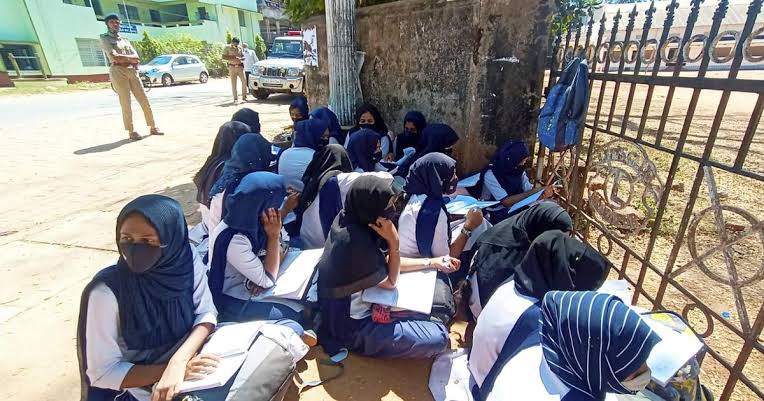
The hijab row started with a sudden move of a university in Udupi, Karnataka locking their doors on six hijab-wearing Muslim students which later escalated quickly as several other schools and universities started implementing the same ban. The news outraged several Muslim students and was heavily criticised across the country.
The universities told the students that the hijab is not a part of the dress code and should not be worn inside the school premises. Protest initially started with Muslim girl students demanding their right to wear hijab inside the classrooms and it later snowballed with students in support of the ban, raising slogans of “Jai Shri Ram” (glory to Lord Ram ) wearing saffron stoles. As per reports, the saffron stoles were being distributed from a vehicle to students supporting the ban.
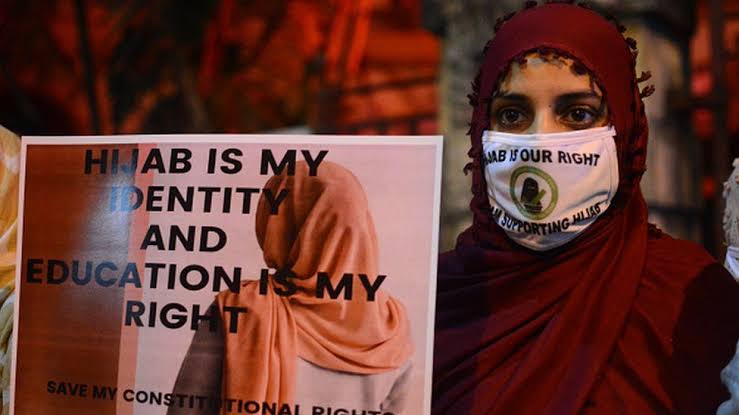
The protest which started as the right to practice religion soon erupted into a clash between students and turned into a political interest. The Karnataka government was of little to no help during the row.
“There is a rule in the constitution regarding uniformity in schools and colleges. Clearly mentioned in the Karnataka Education Act. All these rules are clear as to what’s to be followed. We have issued a notification.” Said Karnataka chief minister Basavaraj Bommai.
The students of Udupi filed a petition in Karnataka high court seeking permission to wear hijab in educational institutions. The verdict of the court came on March 15 dismissing the petition by students and upholding the ban on hijab. Students felt down by the verdict whereas the Karnataka government welcomed it.
Many arguments were raised in the court, one mentioning if a student wants to carry a weapon to school, should that be allowed? It is one bizarre argument to raise, why would the fundamental right to practice religion, to wear a hijab would hurt anyone or would promote violence. The comparison is uncalled for and irrelevant.
“There is sufficient intrinsic material within the scripture itself to support the view that wearing hijab has been only recommendatory if at all it is. What is not religiously made obligatory therefore cannot be made a quintessential aspect of the religion through public agitations or by the passionate arguments in court,” the order says.
The word hijab has been used in Quran five times and it is considered to be an essential part of Islam that many women across the globe follow. So where lies the question about women empowerment and does Islam only asks women to do purdah (cover themselves)?
“Tell the believing men to cast down their looks and guard their private parts; that is purer for them; surely Allah is acquainted with what they do. And tell the believing women that they cast down their looks and guard their private parts and do not display their ornaments except what appears thereof..” – Surah al-Nur ( 24:30:31)
The Quran asks men to lower their gaze before it asks women to cover themselves. Many women like myself feel empowered and liberated by wearing the hijab but one can also not deny that many women are forced to wear it by their families as well.
But does locking them outside the gates of schools and colleges, stopping their education, unless they remove their hijab helps? Education could one day liberate the girls who are being forced to wear hijab to remove it, but many women who choose to wear hijab are getting deprived of making a choice. While the hijab is considered a symbol of misogyny, it is a symbol of expression and power to many. To not give them an option to choose feels like a threat to women’s empowerment.
Schools and universities opened after a two-year-long pandemic but instead of focusing on studies, Muslim students are outside the gates asking for the administration to let them study while practicing their right to religion.
The topic of discussion around media channels was what is more important, Hijab or education? India being the largest democracy that allows every individual to practice their rights, why is it that they have to choose when they can very well do both without compromising any.
According to the 2021 study based on the 2005-06 national family health survey, the dropout rate among Muslims is 17.6%, higher than the all- India average of 13.2%. According to The Quint close to 5,000 Muslim students missed classes and examinations in Karnataka after HC asked students to give their exams without the hijab till they make a decision and the numbers are likely to increase after the Karnataka HC order.
The court’s decision has put the future of Muslim students in jeopardy across the country, many families are likely to take their daughters out of school and universities. The court could have put a stop to this.
While many political parties criticised the Karnataka High Court’s order, BJP hailed the order in the context of “women empowerment”. The party that launched the Beti Bachao Beti Padhao campaign said nothing after the saffron mobs attacked a “beti” when she was entering the college but came forward in support of the order showing nothing but the heights of their hypocrisy.
Considering Hijab as an “Arab culture” and depriving Muslim women students to choose cannot be linked to women empowerment but pure hatred and conspiracy against a particular religion. Since 2014, the cry to save Muslim women from Muslim men by the government and saffron-wearing mobs has only grown. The government cannot choose when to listen to Muslim women and when not to. Muslim women are more than their political agenda, more than a story one chooses to debate on. Today’s Muslim women know what they want, is well aware of their rights, and nothing could stop them from asking for it, be it the women of Shaheen Bagh, who did not leave the protest site for months or the Udupi Muslim students who are fighting for their right at such a young age.
Conclusion
Religious politics have only increased in India since 2014, parties know the weak spots of Indians and are ready to make anything and everything their political agenda. It is up to us to decide when to cut their ties but maybe we’re far from it. Muslim women can fight their battles but with the growing Islamophobia, the court’s decision has put all hijab-wearing Muslims at risk. It gave the saffron mobs another reason to question any hijab-wearing Muslim on their attire and harass them. Education is for all, it’s the job of the government to give quality and equal education to all despite their religion. Many Muslim students have been wearing hijab for years and in the same university then why has it made such chaos now? Muslim students are not denying wearing the uniform, they are just covering their head with a plain hijab not accessorising. If the court or the government bans the hijab is it ready to remove all religious symbols, be it tilak, Kada, kirpan, or turban?
Masha Allah, May Allah bless you for this beautiful article and many more, Thanks